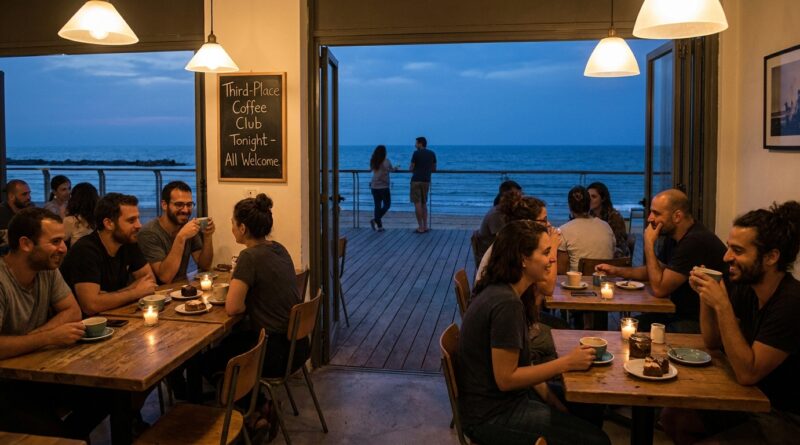
Why Tel Aviv Port’s ‘Third-Place Coffee Club’ Nights Could Be 2026’s Most Needed Cure For Quiet Loneliness
It is a strange kind of loneliness when you are surrounded by people and still feel like nobody would notice if you left. A lot of cafés make that feeling worse. You queue, order, squeeze into a seat, stare at a screen, then hurry out because the room feels built for turnover, not belonging. If you have been craving a place where you can simply sit, talk, and exist for a while, that feeling makes sense. The loss of real third places is not some abstract trend piece. It lands in your body. It shows up as restlessness, social fatigue, and that nagging sense that every public space wants something from you. That is why the idea of Tel Aviv Port’s “Third-Place Coffee Club” nights matters. It is small, local, and refreshingly practical. Not a grand fix for modern loneliness, but a real one. Sometimes the best cure is not more networking, more scrolling, or more productivity. It is one familiar table, one warm drink, and a reason to come back next week.
⚡ In a Hurry? Key Takeaways
- Third place coffee Tel Aviv port nights could help fight quiet loneliness by giving people a regular, low-pressure place to gather.
- Start simple. Pick one evening, go alone or with one friend, stay off your phone for a bit, and return often enough for faces to become familiar.
- This works best because it is affordable, local, and gentle. No big commitment, no performance, and no need to “network.”
Why this idea hits a nerve right now
People miss third places because they used to do a quiet but important job. They gave us somewhere to be that was not home and not work. Somewhere casual. Somewhere human.
That kind of place is harder to find now. Many cafés feel optimized within an inch of their life. Fast service, short stays, laptop rows, constant churn. Useful, sure. Comforting, not always.
When people talk about loneliness, they often picture total isolation. But quiet loneliness is different. It is what happens when your calendar is full, your messages keep buzzing, and you still feel socially underfed.
A regular coffee night at the port can help because it replaces vague longing with a real habit. Instead of saying, “I wish I knew more people,” you start showing up in the same place at the same time. That is how strangers slowly become familiar.
What makes a “third-place coffee” night different
A true third place does not feel like a transaction with chairs. It feels like a living room that happens to serve coffee.
It is not about buying more
You order your drink, yes. But the point is not to keep selling you upgrades every six minutes. The point is to let the evening breathe.
It is not a coworking space in disguise
Laptops have their place. So do deadlines. But a third-place night works best when the social purpose is clear. You came to be around people, not just near them.
It gives regularity without pressure
This may be the magic ingredient. You do not need to be the loudest person in the room. You do not need to make five new friends by the end of the night. You just need to come back.
That is also why pieces like Why Tel Aviv Port’s ‘Slow Coffee, Real Talk’ Table Could Be 2026’s Kindest Antidote To Quiet Loneliness ring true. The need is not only for more events. It is for softer spaces that ask less from people who are already tired.
Why Tel Aviv Port is the right setting
The port already has something many urban places lack. It invites lingering. There is air, space, movement, and a natural flow of people without the boxed-in feeling of a rushed indoor venue.
For locals, it can become a weekly anchor. For digital nomads, it can cut through the floating feeling that comes with temporary living. For short-stay visitors, it offers a better story than another anonymous café stop.
And because Tel Aviv can be intense, in a good way and a draining way, a slower ritual at the port feels almost medicinal. The city moves fast. Nervous systems do not always want to.
How to use it as an actual cure for quiet loneliness
This only works if you treat it as a practice, not a one-off experiment.
1. Go before you feel “ready”
A lot of people wait until they feel outgoing. Bad plan. Most of us do not magically become relaxed at home. Go slightly awkward. Go a bit tired. Go anyway.
2. Set a tiny goal
Do not pressure yourself to have a life-changing conversation. Try one small target. Stay for 45 minutes. Ask one person what they usually order. Say hello to the barista by name.
3. Keep your phone in your pocket
This sounds obvious, but it matters. Phones protect us from discomfort, and they also block accidental connection. If you need a crutch, keep it face down and out of sight.
4. Become a familiar face
Belonging rarely arrives in one dramatic moment. It builds through repetition. The second visit feels easier than the first. The fourth is where the shift often starts.
5. Let weak ties do their job
Not every connection has to become a deep friendship. The person who nods hello, the couple you chat with for five minutes, the staff member who remembers your drink. These “light” connections are not trivial. They steady you.
Who will get the most out of it
Honestly, more people than you might think.
Locals who feel socially rusty
If your friendships have become hard to schedule and your routine feels too sealed off, this creates a low-stakes social lane back in.
Remote workers and freelancers
When work happens alone, days can flatten out. A recurring evening ritual restores some shape to the week.
Newcomers and short-stay visitors
You do not need a giant social circle to feel grounded. Sometimes you just need one place that starts to feel a little known.
What to expect on your first night
Probably not magic. And that is good news.
The best third-place experiences are usually ordinary at first. A few conversations. Some pauses. A moment where you listen more than you talk. A sense that nobody is trying too hard.
That ordinariness is the point. It tells your brain you do not need to perform here. You can just arrive, settle, and be part of the room.
If you walk away thinking, “That was nice, actually,” do not underestimate it. Nice is underrated. Nice repeated becomes trust. Trust repeated becomes community.
At a Glance: Comparison
| Feature/Aspect | Details | Verdict |
|---|---|---|
| Atmosphere | Focused on staying, chatting, and slowing down instead of fast turnover and laptop isolation. | Better for real human contact. |
| Social Pressure | Low-key, repeatable, and friendlier than formal networking events or party scenes. | Good for shy, tired, or socially rusty people. |
| Practical Value | Easy to try this week, supports a local business, and can grow into a healthy ritual. | Simple idea, surprisingly strong payoff. |
Conclusion
Talking about loneliness and the disappearance of third places is trending again because people feel it every day, from Tel Aviv to Los Angeles, but most conversations stop at nostalgia or blame. This idea is better because it gives you something concrete to do. Pick one evening. Walk down to the port. Join a small circle of regulars and almost-regulars. See what happens when a local café acts like a public living room instead of a fast-coffee pipeline. That one choice can help Tel Aviv locals, digital nomads, and short-stay visitors turn a random night into a ritual. It supports a genuinely local business. More than that, it models a kinder, slower way to be together in a city that often runs too fast for our nervous systems. You do not need a perfect social life. You may just need one place that starts to feel like yours.