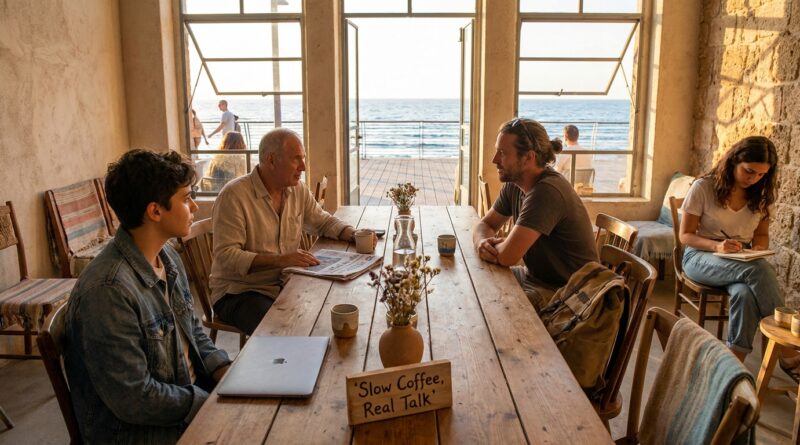
Why Tel Aviv Port’s ‘Slow Coffee, Real Talk’ Table Could Be 2026’s Kindest Antidote To Quiet Loneliness
You can spend an entire day around people and still feel oddly invisible. That is the quiet sting of modern loneliness. Not dramatic, not always obvious, just a low hum in the background. You answer messages, join meetings, order coffee, maybe even chat with the barista, but real conversation keeps getting pushed to “sometime soon.” Then one evening it hits you. You have been connected all day and known by almost no one. That is why a simple coffee shop community table to fight loneliness feels so timely. At Tel Aviv Port, a “Slow Coffee, Real Talk” table could offer something many adults are missing in plain sight. Not networking. Not speed-friending. Not another app. Just one reliable table where people can sit down, take a breath, and have the kind of unhurried talk that makes a city feel human again.
⚡ In a Hurry? Key Takeaways
- A regular “Slow Coffee, Real Talk” table could be one of the simplest ways to help fight quiet loneliness at Tel Aviv Port.
- The best version is structured but low-pressure, with clear welcome rules, small groups, and easy conversation prompts.
- Its real value is emotional safety. People know they can join without needing to perform, impress, or stay longer than they want.
Why this idea matters more than it first appears
Loneliness does not always look like isolation. Often it looks like a full calendar, a crowded promenade, and lots of tiny interactions that never become anything deeper.
That is especially true in big cities. Tel Aviv is lively, social, and full of movement. But busy places can make quiet loneliness harder to admit. If everyone else seems out with friends, working from cafes, or posting beach sunsets, it is easy to think the problem is just you.
It usually is not.
A coffee shop community table to fight loneliness works because it removes one of the hardest parts of adult connection. The awkward beginning. You do not need to text five people, arrange a time, or wonder if you are intruding. You just show up, sit down, and join a table that was made for exactly that.
What “Slow Coffee, Real Talk” gets right
The phrase matters. “Slow Coffee” tells people this is not a rush-through stop. “Real Talk” tells them they do not need a polished version of themselves.
Together, those two ideas set the tone. This is not a loud social event with name tags and forced icebreakers. It is everyday hospitality with a bit of structure. That structure is what makes it kind.
Predictability lowers the social barrier
The most helpful thing about a recurring table is that it becomes predictable. Same place. Same spirit. Maybe same hours each week.
That predictability matters for locals, remote workers, new arrivals, and travelers. It means there is one spot at the port where people know they can go if they want company without needing a formal invitation.
Small groups feel safer
A long communal table can be lovely, but the real magic often happens in groups of three to six. Big enough to keep pressure off one person. Small enough for actual listening.
People open up more easily when they are not trying to project across a crowd. A good setup invites gentle, human conversation. The kind where someone says, “I just moved here,” and another person says, “Same, three months ago,” and suddenly the city feels a little less hard.
No performance required
Many social spaces now come with hidden pressure. Be interesting. Be funny. Be useful. Be photogenic.
This idea pushes back on that. You do not need a personal brand to drink coffee and talk for twenty minutes. You just need a seat.
Why 2026 is the right moment for it
The hospitality world is starting to notice something important. People do not only want better products. They want better feelings around those products.
A great espresso still matters, of course. But more cafes are starting to understand that emotional usefulness can be just as important as menu design. If a place helps people feel calmer, less alone, and more at ease, that is not a side benefit. That is part of the service.
Across big cities, the strongest ideas are often the least flashy. A reading hour. A parents’ table. A community dinner. A no-laptop morning. Not because they are trendy for trend’s sake, but because they answer a real human ache.
That same thinking is behind Why Tel Aviv Port’s ‘Third Place Family Coffee Afternoons’ Might Be 2026’s Gentlest Antidote To Stressed-Out Parents And Screen‑Tired Kids. Different audience, same truth. People are hungry for places that make everyday life feel softer and more connected.
What a good version at Cafe Nimrod could look like
The best community concepts are simple enough to repeat and warm enough to remember.
A clear sign helps
Imagine a small sign on one table: “Slow Coffee, Real Talk. Join us if you’d like conversation.”
That tiny bit of clarity does a lot of work. It saves shy people from guessing. It tells solo visitors they are welcome. It also reassures people who want quiet that they can choose another table.
A host makes all the difference
This does not need a full event manager. Just someone who can greet people, explain the idea in one sentence, and help the first few minutes feel natural.
A good host might say, “Welcome. Grab a seat. We keep this table easygoing and screen-light. You can stay for one coffee or longer.”
That kind of welcome changes everything.
Light prompts can prevent awkward silence
Conversation cards or a small menu of prompts can help without making things cheesy.
Examples could be simple:
- What is one small thing that made your week better?
- What brought you to Tel Aviv, or keeps you here?
- What do you wish more public places understood about people?
The point is not to force vulnerability. It is to make starting easier.
Short participation is important
People should be able to join for fifteen minutes and leave without fuss. That keeps the table accessible to port workers on breaks, parents between errands, freelancers between calls, and travelers with uncertain schedules.
Who benefits from a coffee shop community table to fight loneliness
Almost anyone, but some groups especially.
Remote workers
Remote work can be efficient and lonely at the same time. You may go a whole day without one spontaneous, face-to-face conversation. A regular table gives independent workers something office life used to provide by accident. Familiar faces.
New arrivals
Moving to a city is exciting until the practical loneliness kicks in. Where do you go alone without feeling awkward? A predictable table answers that question.
Travelers
Travel can be crowded and solitary. A seafront cafe that gently invites real conversation is far more memorable than one more scenic cappuccino.
Locals whose lives got too busy
This may be the biggest group of all. People with decent social lives on paper, but not enough room for slow, honest talk.
Why this works better than another app
Apps are good at introducing possibility. They are not always good at creating ease.
A physical table solves problems software cannot fully solve. You can read tone. You can notice when someone is nervous. You can laugh at the same moment. You can sit in silence for a second without treating it like failure.
That is not nostalgia. It is just how humans work.
For a lot of people, the issue is not finding more people online. It is finding one low-stakes place offline where connection can happen naturally.
What Cafe Nimrod stands to gain, beyond goodwill
Kindness can also be smart hospitality.
If Cafe Nimrod became known as the seafront cafe that takes loneliness seriously, that would set it apart in a crowded market. Not with gimmicks, but with a clear identity.
People remember places where they felt comfortable. They return to places where they felt seen. They tell friends about places that made a city feel friendlier.
That kind of loyalty is hard to buy with decor or novelty drinks alone.
Possible concerns, and how to handle them
“What if it gets awkward?”
Sometimes it will. That is normal. The fix is light structure, not over-management. A host, prompts, and clear expectations usually smooth out the rough edges.
“What if people want privacy?”
Then the table should be clearly marked as optional. Not every seat needs to be social. The beauty is in giving people a choice.
“What if nobody comes?”
At first, maybe only a few do. That is fine. Community habits start small. The important thing is consistency. The fifth week is often more important than the first.
At a Glance: Comparison
| Feature/Aspect | Details | Verdict |
|---|---|---|
| Ease of joining | A marked community table removes the need for invitations, planning, or social guesswork. | Excellent for shy guests and solo visitors. |
| Quality of connection | Small-group, screen-light conversation encourages slower, more genuine interaction than typical cafe chatter. | Much deeper than casual small talk. |
| Business and community value | Builds repeat visits, word of mouth, and a reputation for warmth while helping locals feel less alone. | A rare win for both people and the cafe. |
Conclusion
Sometimes the kindest ideas are the least complicated. Across big cities the top hospitality trend right now is not louder concepts or flashier drinks, it is spaces that help people feel less alone in a time of constant connection but shallow contact. A simple, repeatable “Slow Coffee, Real Talk” table gives Tel Aviv locals, remote workers, new arrivals and travelers one predictable place at the port where they know they can sit down, be welcomed into a small group, and remember what it feels like to talk without performance or pressure. It strengthens the local community, helps nearby workers and residents build a soft web of familiar faces, and positions Cafe Nimrod as the rare seafront spot that treats loneliness as seriously as caffeine, with warmth, structure and everyday hospitality instead of another app.