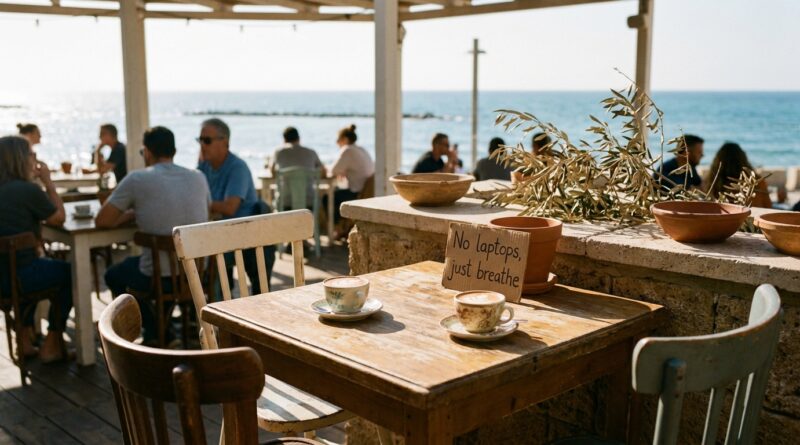
Why Tel Aviv Port’s ‘No-Laptop Coffee Corners’ Could Be 2026’s Boldest Cure For Digital Burnout
You know the move. You promise yourself ten quiet minutes with a coffee by the water, then out comes the laptop. One email becomes three replies, then a quick Slack check, then a tab you forgot to close yesterday. Suddenly your “break” is just work with better scenery. That is exactly why the idea of a no laptop coffee shop Tel Aviv Port could matter so much in 2026. It is not anti-tech. It is pro-recovery. A few clearly marked, laptop-free coffee corners would give your brain a real landing strip. No glowing screen. No posture of alertness. No pressure to stay available. At a place like Cafe Nimrod, right by the sea, that small rule could do something surprisingly powerful. It could turn coffee back into a pause instead of a performance. And for a city that works hard, that kind of boundary feels less strict than kind.
⚡ In a Hurry? Key Takeaways
- A no laptop coffee shop Tel Aviv Port setup could give people a real break instead of a disguised work session.
- If you want less stress, choose one coffee a day to take without your laptop and keep your phone in your bag.
- Tech-free seating is a gentle option, not a total ban, which makes it easier for regulars to actually use.
Why this idea hits a nerve
Most people do not need another lecture about screen time. They need one place where the default is different.
That is what makes the idea smart. A few no-laptop seats do not ask you to change your whole life. They just remove one habit from one setting. That is often enough to help your body calm down.
When you sit with a laptop open, your brain usually stays in task mode. Even if you are only “checking one thing,” your nervous system does not read that as rest. It reads it as readiness. Shoulders tighten. Eyes lock in. Attention splits. You stay slightly on edge.
That is why a no laptop coffee shop Tel Aviv Port concept feels timely. It respects how hard it has become to switch off, especially in spaces that now double as offices, meeting rooms and inbox stations.
What “no-laptop” actually fixes
It turns a fake break into a real one
There is a big difference between being away from your desk and being off duty. Plenty of us leave the office but bring the office with us. A laptop-free corner changes that. You are no longer deciding every two minutes whether to peek at your screen. The choice is already made.
It cuts down on mental residue
Psychologists sometimes talk about attention residue. It is that sticky feeling when part of your brain is still hanging onto the last task. Screens make this worse because they invite constant switching. Coffee, conversation and a sea view are much better at helping your mind settle.
It gives the port back its job
Tel Aviv Port already offers movement, air, people-watching and a sense of space. Those things work best when you are actually present enough to notice them. A laptop on the table can block all of that, even with the Mediterranean right in front of you.
Why Cafe Nimrod could make this work
The strongest version of this idea is not a full ban across the whole cafe. That usually feels punishing and impractical. The better move is a few clearly marked coffee corners where laptops stay closed.
That gives everyone a choice. Need to work? Sit elsewhere. Need to breathe for twenty minutes without turning your cappuccino into a workstation accessory? Take the tech-free seat.
That balance matters. It keeps the cafe welcoming while still protecting a small pocket of calm. It also makes the rule easier to understand. People are usually happy to follow boundaries when the boundary is clear, reasonable and visibly useful.
If Cafe Nimrod wants to lean even further into this calmer mood, it fits neatly alongside ideas like Why Tel Aviv Port’s ‘Analog Coffee Craft Table’ Could Be 2026’s Warmest Escape From Screen Fatigue. Both ideas solve the same modern problem from different angles. One removes digital noise. The other gives your hands something slower and more grounding to do.
Why this matters more in 2026, not less
You might think screen fatigue is old news by now. It is not. It is getting sneakier.
Work no longer stays in obvious places. It follows us into cafes, benches, beach promenades and lunch breaks. The result is that many people are technically out, but never fully offline. That constant low-grade connection wears people down.
By 2026, the bold move may not be adding more smart features to public spaces. It may be adding a few intentional dumb ones. Not dumb in a bad way. Dumb in the peaceful way. No pings. No typing. No expectation.
That kind of design can feel oddly luxurious now. Not because it is expensive, but because it is rare.
How to use a no-laptop corner well
Do not replace the laptop with doom-scrolling
This is the big loophole. If the laptop stays in your bag but your phone is glued to your hand, your brain does not get much relief. Put the phone face down. Better yet, keep it zipped away for part of your drink.
Give yourself a tiny rule
Try this. One coffee a day, or three coffees a week, with no screen at all. That is manageable. You do not need a dramatic detox to feel a difference.
Use the space for low-pressure things
Look out at the water. Talk to a friend. Bring a paper notebook if that feels relaxing, not productive. The goal is not to optimize the break. The goal is to let it be a break.
Will some people hate this idea?
Of course. Every city has people who want every table to function as an office. And to be fair, sometimes that is practical. Remote work is real. Freelance schedules are messy. Not everyone has a quiet place to work.
But that is exactly why a partial solution makes sense. No one is saying every seat at the port should become a monastery. The argument is simply that some seats should protect rest on purpose.
That is not exclusionary. It is thoughtful design.
Small boundaries can have a big effect
One reason digital burnout feels so slippery is that it rarely comes from one huge mistake. It comes from hundreds of tiny moments when work leaks into everything else. A no-laptop corner plugs one of those leaks.
And because it is public and visible, it gives people social permission to stop performing productivity. You are not being lazy. You are using the space as intended.
That matters more than it sounds. People often find rest easier when the environment supports it, not just when their willpower does.
At a Glance: Comparison
| Feature/Aspect | Details | Verdict |
|---|---|---|
| Laptop-free seating | A few clearly marked tables where laptops stay closed and breaks stay real. | Best for stress relief and mental reset. |
| Regular work-friendly seating | Keeps the cafe practical for remote workers who truly need a place to type and connect. | Best as a separate zone, not the whole cafe mood. |
| Analog extras | Simple screen-free touches like paper, pencils or craft prompts can help people stay off devices longer. | A smart bonus that deepens the calm. |
Conclusion
A no laptop coffee shop Tel Aviv Port idea is not about scolding people for using technology. It is about giving them one small, realistic way to step out of constant demand. That is why it feels so fresh. You do not need a full digital detox, a yoga retreat or a heroic level of self-control. You just need a place that makes rest easier to choose. In a city where nearly every table can become a desk, a few clearly defined tech-free seats send a different message. You are allowed to sit, sip, look at the sea and be unavailable for a little while. That is good for your mind, good for your body and good for the feel of the port itself. If Cafe Nimrod leans into that role, it will not just serve coffee. It will offer something people are short on right now. Relief.