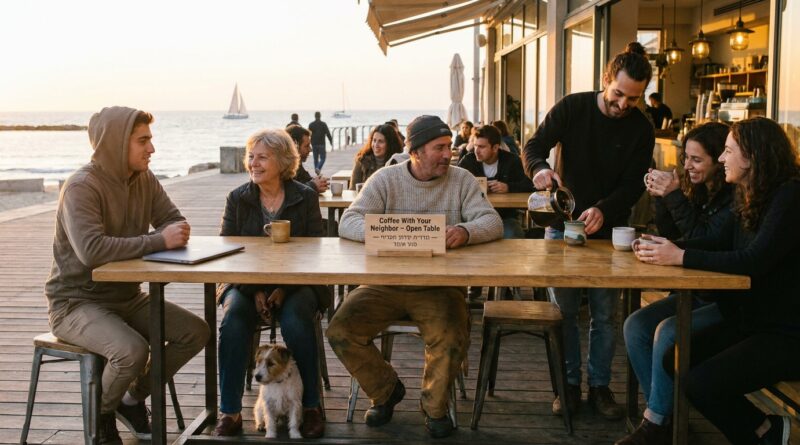
Why Tel Aviv Port’s New ‘Coffee With Your Neighbor’ Table Could Be 2026’s Kindest Way To Feel Safer In Your Own City
A lot of people in Tel Aviv are carrying a quiet tension right now. You still go to places you love, like the port, but the mood is different. A walk at sunset can feel a little watchful. Sitting alone with a coffee can take more effort than it used to. That is why a simple idea like a tel aviv community coffee event tel aviv port setup matters more than it sounds. Not another speech. Not a branded wellness campaign. Just a shared table where neighbors can sit down, talk for a few minutes, and leave feeling a bit more grounded. On a day like October 7, when the US marks National Coffee With A Cop Day, the bigger lesson is easy to understand. Safety is not only patrols, gates, and alerts. It is also eye contact, familiar faces, and small conversations that remind you a public place still belongs to ordinary people. That is where Cafe Nimrod’s “Coffee With Your Neighbor” table could really help.
⚡ In a Hurry? Key Takeaways
- A “Coffee With Your Neighbor” table at Tel Aviv Port could help people feel safer by making the space feel more familiar and human.
- Keep it simple. A visible shared table, light ground rules, and short drop-in chats work better than a formal event.
- The real value is emotional safety. Repeated small conversations can slowly rebuild trust in a public place people already want to love again.
Why this small idea feels bigger than it looks
When people say they want to feel safer in a city, they do not always mean they want more noise, more announcements, or more official programming. Often, they want the opposite. They want to stop feeling alone in public.
That is what makes this kind of coffee table so interesting. It does not try to fix everything. It just lowers the social temperature. You see a table. You see a few people talking. You realize you can sit for ten minutes without needing a perfect reason.
That is a useful kind of safety. Not dramatic. Not flashy. But real.
What National Coffee With A Cop Day gets right
The US idea behind National Coffee With A Cop Day is refreshingly plain. Put people and local safety figures in the same casual space, remove the big agenda, and let normal conversation do some of the work.
The point is not that one coffee solves fear. It does not. The point is that trust grows in repeated, low-pressure moments. You stop seeing every interaction as formal. You start recognizing faces. Questions become easier to ask. Worry gets a little less loud.
In Tel Aviv, that same logic can work even without uniforms at the center of it. Neighbors, shop staff, familiar regulars, and off-duty service providers can all help create the same effect. A public place feels safer when it feels socially stitched together.
Why Tel Aviv Port is the right kind of place for it
The port already has one big advantage. People want to be there.
That matters. It is much easier to rebuild ease in a place that already has good memories attached to it. Families walk there. Friends meet there. People grab coffee there before heading home. You are not asking residents to adopt a strange new setting. You are helping them reconnect with a familiar one.
A dedicated coffee table works especially well in a place like this because it blends into daily life. Someone can join for five minutes. Someone else can stay for half an hour. Nobody has to sign up, perform, or explain themselves.
What a “Coffee With Your Neighbor” table should actually look like
Keep the setup visible and easy
The best version is not hidden in a corner. It should be clearly visible, close enough to normal cafe flow that it feels welcoming, but not so central that shy people feel put on display.
Use light ground rules
A small sign can do a lot of work. Something like: “Sit down. Listen well. Keep it kind. No pressure to stay.” That tells people what this is and what it is not.
Welcome short conversations
Not every meaningful chat needs to be deep. Sometimes the win is simply, “I come here too.” That sounds minor. It is not. Familiarity is a big part of how humans judge safety.
Mix regulars with local workers
If nearby shop staff, cafe regulars, and off-duty public service workers occasionally use the table, the whole thing becomes more stable. It starts to feel less like a one-off social experiment and more like part of the port’s daily rhythm.
Why this could help people who are not looking for “community events”
Some people hear “community event” and immediately think, not for me. Too organized. Too awkward. Too much talking in circles.
Fair enough.
This is different because it is soft-edged. You do not have to arrive at a certain time. You do not have to share anything personal. You can just listen. For many tired, overstimulated city residents, that is the whole appeal.
It also helps that coffee gives a social interaction a natural time limit. You sit. You sip. You talk a little. Then you leave. That makes it less intimidating than a full meetup or public discussion panel.
If that idea sounds familiar, it connects neatly with Why Tel Aviv Port’s New ‘Third-Place Coffee Table’ Could Be 2026’s Safest Shortcut Out Of Lonely Weeknights, which touches on how one shared table can make public life feel easier, especially after work when isolation tends to creep in.
The hidden tech lesson here, oddly enough
As a tech columnist, I spend a lot of time writing about tools that promise connection. Apps. Feeds. safety alerts. neighborhood groups. Those can be helpful. But they also keep many people in a constant state of scanning.
You read one warning, then another. You check comments. You look at a map. You absorb everybody’s stress at once. Soon, the city feels more dangerous than the moment in front of you actually is.
A shared physical table does something digital tools often cannot. It narrows your focus to the human beings right there. It turns abstract anxiety into manageable conversation. You leave with context, not just alerts.
How Cafe Nimrod could make it work without overcomplicating it
The smartest move would be to treat this as an ongoing habit, not a launch event.
Start small
One table. Clear hours. No fuss.
Let the mood stay casual
No microphone. No formal host voice. A staff member can gently welcome people, but the table should feel like an invitation, not a program.
Build consistency
If people know the table is there on ordinary weekdays, trust grows. Predictability matters. Safety often feels like knowing what you will find when you arrive.
Protect the tone
If the table turns into debates, complaints, or performative speeches, people will avoid it. The goal is simple listening and neighborly contact. That tone needs tending.
At a Glance: Comparison
| Feature/Aspect | Details | Verdict |
|---|---|---|
| Formal safety panel | Useful for information, but can feel heavy, structured, and easy to skip if people are already stressed. | Good occasionally, not ideal for everyday ease. |
| Neighborhood WhatsApp or social feeds | Fast and convenient, but often full of anxiety, rumors, and constant alert-mode thinking. | Helpful for updates, weak at creating calm. |
| “Coffee With Your Neighbor” table | Low-pressure, face-to-face, easy to join for a short time, and built around familiar public space. | Best option for rebuilding trust slowly and naturally. |
Conclusion
Sometimes the kindest fix is not a big fix. It is a small, repeatable one. Today, October 7, is officially National Coffee With A Cop Day in the US, a grassroots idea built on something very simple: when people and the folks who keep their streets safe talk over coffee without an agenda, trust slowly grows and fear slowly shrinks. That same spirit matters in Tel Aviv right now, where many residents quietly say they miss feeling relaxed in public spaces but do not really want another big formal event or panel. A soft, ongoing “Coffee With Your Neighbor” table at the seaport gives people something more human and manageable: one shared surface, clear ground rules for listening, and a cup of coffee that lasts just long enough to remember that most of us want the same thing, a city that feels kind again. By inviting regulars, nearby shop staff and even off-duty service providers to use this table as a low-key listening post, Cafe Nimrod can turn everyday daylight and sunset hours into a steady drip of micro-conversations that slowly rebuild confidence in the port as a gentle, communal place rather than another anxious crossroads.