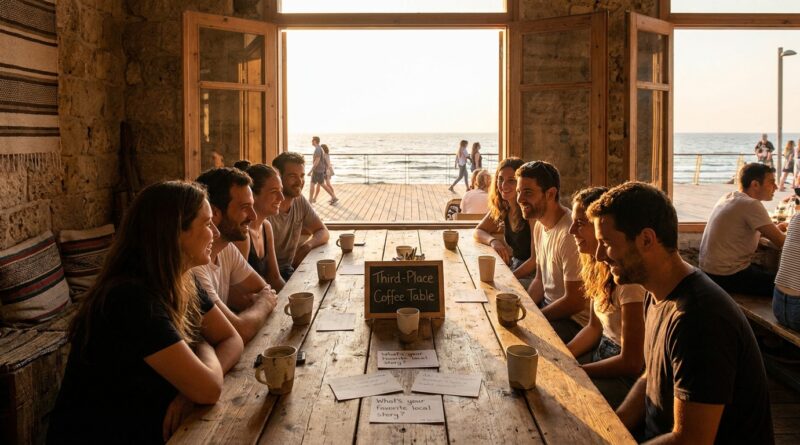
Why Tel Aviv Port’s New ‘Third-Place Coffee Table’ Could Be 2026’s Safest Shortcut Out Of Lonely Weeknights
You know the feeling. Work ends, your phone wins an hour of your life, and even if you walk by the sea at Tel Aviv Port, you still get home with that flat, oddly lonely feeling. Not dramatic loneliness. Just the kind that comes from being around people all day without really connecting to anyone. If bars feel loud, networking events feel fake, and inviting yourself into someone else’s group feels awkward, the idea behind a third place coffee shop tel aviv port setup starts to make a lot of sense. The new Third-Place Coffee Table at Cafe Nimrod is simple on purpose. It gives people a calm, normal place to sit down near others, without having to perform, flirt, pitch, or pretend to be “on.” Sometimes the safest shortcut out of a lonely weeknight is not a big plan. It is one familiar table, one coffee, and twenty unhurried minutes in the same place often enough for strangers to stop feeling strange.
⚡ In a Hurry? Key Takeaways
- The Third-Place Coffee Table at Tel Aviv Port works because it makes casual human contact feel normal, easy, and low-pressure.
- Pick one evening this week, sit for twenty minutes, keep your phone away, and let simple nods or short comments do the work.
- It is safer and more comfortable than bars or forced mixers because the whole point is calm repetition, not instant intimacy.
Why this idea lands right now
People keep talking about the loss of “third places” because the problem is real. Home is one place. Work is another. After that, many of us just drift into apps, errands, or expensive nights out that do not actually leave us feeling known.
That is why a third place coffee shop tel aviv port concept feels bigger than it sounds. It is not just about coffee. It is about having somewhere to go where you do not need a reservation, a wingman, a big budget, or a polished reason to be there.
The port already has one big advantage. People arrive there in a softer mood. They are walking, slowing down, looking at the water, taking a breath after the day. Put a shared table into that setting, and the social temperature changes. You are not squeezing connection into a loud room. You are letting it happen in a place built for lingering.
What the “Third-Place Coffee Table” actually does
The smartest part of this idea is that it removes one of the hardest bits of adult social life, the opening move.
Normally, talking to strangers feels like breaking a rule. At a shared table designed for exactly that purpose, the rule flips. Sitting down is the invitation. A smile counts. A quick “is this seat free?” is enough to begin.
There is no need to turn it into a deep life story. In fact, it works better when you do less. A short comment about the breeze. A question about what someone ordered. A familiar face you notice for the second week in a row. This is how community usually starts. Not with fireworks. With recognition.
Why it feels safer than bars or events
Bars often push people into fast, noisy, alcohol-led conversations. Networking events can feel like everyone is selling something. The Third-Place Coffee Table offers a gentler format.
You can leave whenever you want. You can sit quietly without seeming rude. You can speak to one person, or no one, and still feel part of a shared room. That low pressure matters. It helps shy people, tired people, solo visitors, and locals who want company without social theater.
The real value is repetition, not instant chemistry
Here is the bit most people miss. The table is not magic because one night will suddenly give you a new best friend. It is useful because it gives you a repeatable ritual.
If you show up once, you may simply enjoy a calmer evening. If you show up regularly, people begin to recognize you. Then the nod comes. Then the name. Then the easy chat. Over time, that is how a city stops feeling anonymous.
This is also why the setup fits so well with the wider conversation about urban loneliness. We do not just need more places to spend money. We need more places where familiarity can build without pressure.
If that idea speaks to you, you may also like Why Tel Aviv Port’s ‘Quiet Coffee Corners For Two’ Could Be 2026’s Softest Answer To The Loneliness Epidemic, which looks at the same need from a quieter, one-on-one angle.
How to try it without making it a big thing
The best plan is the smallest one.
Step 1: Choose one specific night
Do not wait until you “feel social.” Pick a night now. Treat it like a gentle appointment, not a dramatic self-improvement challenge.
Step 2: Aim for twenty minutes
You are not committing to an entire evening. Twenty minutes is enough to settle in, look up, and see what happens. If you stay longer, great. If not, you still did the important part.
Step 3: Keep the phone out of your hands
This one is harder than it sounds. A phone creates a tiny wall. If you want people to feel they can speak to you, your face has to be available.
Step 4: Use easy openers
Try simple lines that do not corner anyone. “Have you been here before?” works. “What’s good here?” works. Even “This is a nice spot at this hour” works. Small is good.
Step 5: Let the evening count, even if the chat is brief
Success is not measured by getting invited to a birthday dinner by 9 p.m. Success is showing up, being present, and making it easier for the next interaction to happen.
Who this is especially good for
This kind of shared coffee table can be useful for more people than you might think.
- Locals who feel oddly isolated despite living in a busy city
- Remote workers who miss casual after-work contact
- New arrivals to Tel Aviv who want company without club energy
- Visitors staying nearby who want a real neighborhood feeling
- Anyone tired of dating-app energy spilling into every social space
That last one matters. Not every social place has to be romantic, loud, or strategic. Some places should simply help people feel less alone.
Why Tel Aviv Port is the right setting
Location is not a minor detail here. It is half the idea.
Tel Aviv Port already invites people to pause. The sea does some of the work. The walking paths do some of the work. The light, the air, and the slower pace all help lower the awkwardness that often comes with talking to strangers indoors.
A third place coffee shop tel aviv port setup also feels accessible. You do not need to know a secret scene. You do not need to dress for a door policy. You can simply arrive as you are after work, after a walk, or before heading home.
At a Glance: Comparison
| Feature/Aspect | Details | Verdict |
|---|---|---|
| Social pressure | Shared seating invites light conversation, but quiet sitting is still completely normal. | Much easier than bars or networking nights. |
| Cost and commitment | Usually just the price of a coffee and twenty minutes of your evening. | Low-risk way to test a new routine. |
| Chance of real connection | Best when visited regularly, because familiar faces turn into names over time. | Strong long-term value, even if one visit stays quiet. |
Conclusion
Across the world, people are finally saying out loud what many have felt for years. There are not enough third places left. Adult life has shrunk to work, home, and a glowing screen, and that can feel lonely even in a packed city. The good news is that the answer does not always have to be grand. It can be practical. It can be local. It can be one table at Cafe Nimrod. So try the ritual. Choose one night this week, head to the Third-Place Coffee Table at the port, sit for twenty unhurried minutes, and let recognition build slowly from nods to names to real conversation. That is how a café starts to feel like a living room, and how a weeknight starts to feel like it belongs to you again.