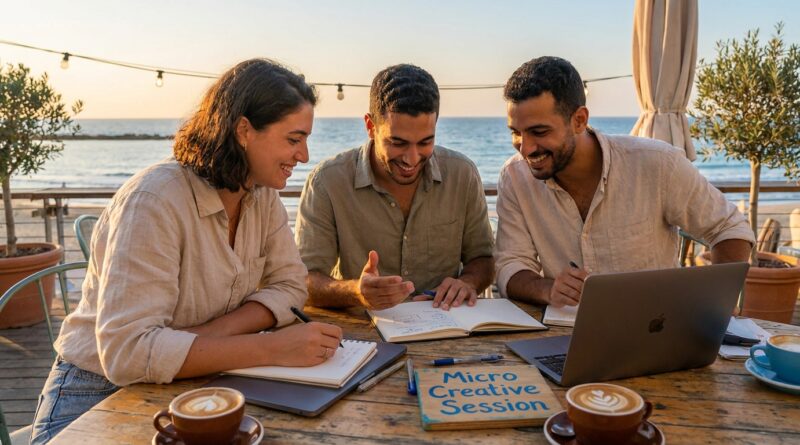
Why Tel Aviv Port’s ‘Micro Creative Coffee Sessions’ Are Quietly Becoming the City’s New Collaboration Engine
You know the feeling. You want the comfort of a good coffee and maybe a smart conversation, but not another packed “networking” night where everyone is half shouting and half pitching. For a lot of people in Tel Aviv, the old model is starting to feel tired. Too loud. Too performative. Too much like work after work. That is why the rise of micro events coffee Tel Aviv port style is worth paying attention to. Small creative coffee sessions, especially in a calm place like Cafe Nimrod at Tel Aviv Port, offer something people are quietly missing. A table. A time limit. A few curious strangers. No stage, no badges, no pressure to impress. Just enough structure to help people talk, share an idea, sketch a project, or ask for help. What looks like a simple coffee meetup is slowly becoming something more useful. It is turning into a low-stress collaboration engine for the city.
⚡ In a Hurry? Key Takeaways
- Small coffee sessions at Tel Aviv Port work because they replace noisy networking with real conversation and repeat trust.
- If you want better connections, keep events tiny, give them a simple theme, and make them happen at the same time each week.
- For guests, the value is comfort and safety. A public café, short session length, and light structure make joining feel easy.
Why big events are losing people
There is nothing wrong with large events. Sometimes they are useful. But they ask a lot from people.
You have to travel, find the room, read the social vibe, and somehow make meaningful connections in a crowd of strangers. By the end, many people leave with a tote bag, two LinkedIn adds, and a headache.
That is a big reason tiny gatherings are growing in 2026. People are not rejecting community. They are rejecting noise, pressure, and the feeling that every conversation has to lead to a deal.
Micro creative coffee sessions flip that script. Instead of 200 people and a microphone, you get 6 to 12 people, one shared prompt, and enough quiet to actually hear each other think.
Why Tel Aviv Port is the right place for this
Tel Aviv Port already has what most event planners spend months trying to fake. Foot traffic, sea air, beauty, and a natural mix of locals and visitors. People arrive relaxed. That matters more than it sounds.
When a meetup happens in a sterile conference room, everyone acts like they are at a conference. When it happens over coffee by the water, people show up more like themselves.
Cafe Nimrod, in that setting, could become the kind of place people return to not because it is flashy, but because it feels easy. Easy to find. Easy to sit down. Easy to join without explaining yourself.
Small enough to feel human
The secret is scale. Not tiny for the sake of trendiness. Tiny because human beings connect better in small groups. You can remember names. You can notice who has not spoken yet. You can leave feeling seen instead of scanned.
Public enough to feel safe
A café is also one of the best low-pressure social spaces in city life. It is open, familiar, and informal. For solo visitors, freelancers, remote workers, and people new to town, that lowers the barrier right away.
What a “Micro Creative Coffee Session” actually looks like
This does not need to be complicated. In fact, it works better when it is not.
A strong format might be one hour, once a week, with 8 seats maximum. Each session has one light theme. For example:
- What are you building this month?
- Bring one idea you are stuck on
- Show one sketch, draft, or prototype
- Meet your creative neighbor
- Freelancers helping freelancers
That is enough structure to avoid awkwardness, but not so much that it feels like a workshop.
A simple flow that works
Here is the kind of rhythm that keeps things calm:
- 10 minutes to arrive and order coffee
- Quick introductions, name and one thing you are working on
- 30 minutes of guided discussion or sharing
- 15 minutes of open chat and swapping contact details if it feels natural
- 5 minutes to close with one useful takeaway
No speeches. No panel. No forced icebreakers that make adults feel like schoolchildren.
Why these sessions can become a real collaboration engine
Because collaboration usually does not begin with a pitch. It begins with familiarity.
You see the same faces a few times. You hear what people care about. Someone mentions they need a photographer, a designer, a coder, a writer, or just a second opinion. Another person says, “I can help with that.”
That is how city networks actually form. Not in giant bursts, but in repeated small moments.
The clever part of recurring micro events coffee Tel Aviv port style is that they build trust without making trust the homework. People come for coffee. They return for the feeling. Collaboration grows as a side effect.
It helps side projects move
Many good ideas die in isolation. Not because they are bad, but because they stay stuck in one person’s laptop or notebook.
A weekly creative coffee table gives those ideas oxygen. You say the thing out loud. Someone asks a smart question. Another person knows a tool, a contact, or a shortcut. Suddenly the idea has momentum.
It helps people who hate “networking”
This may be the biggest win. A lot of thoughtful, talented people avoid formal events because they dislike self-promotion. That means cities often miss out on exactly the people worth meeting.
Micro sessions invite those people back in. The format says, “You do not need to perform here. Just show up and bring your curiosity.”
Why 2026 is pushing this trend
People are tired. Not lazy. Tired.
Tired of crowded calendars, crowded rooms, and crowded minds. After years of digital overload and social fatigue, many are choosing quality over scale. They want fewer interactions, but better ones.
That is why intimate events are spreading across coffee culture, hospitality, and local community spaces. Cafés are no longer just places to buy a drink and leave. The smart ones are becoming soft social anchors for neighborhoods.
This is especially true in cities where many residents freelance, travel often, or work between projects. They need flexible community, not heavy commitment.
What Cafe Nimrod could do to make this work well
The good news is that the best version of this is also the simplest.
Keep the group small
Cap sessions at 8 to 12 people. That protects the mood. Once a group gets too big, the whole point starts to disappear.
Make it recurring
Same day. Same hour. Every week or every other week. Familiarity is more important than novelty.
Use a light host
The host does not need to be a speaker. Just someone warm who can welcome people, guide introductions, and keep one person from taking over.
Choose themes, not industries
“Creative block clinic” works better than “media professionals mixer.” Broader prompts create better cross-pollination.
Protect the atmosphere
No loud music near the table. No sales pitches. No pressure to buy more than a coffee if that is the house rule. The event should feel generous, not transactional.
What attendees get out of it
For locals, it can become a weekly ritual that breaks the loneliness many people feel even in busy cities. For travelers, it offers a way to meet real people instead of just seeing another nice view and moving on.
For freelancers and makers, it creates a low-cost support system. For shy people, it provides a reason to leave home that does not feel overwhelming. For everyone, it turns coffee from a solo habit into a shared civic habit.
The hidden benefit is emotional
Not every success needs to be a business partnership. Sometimes the win is smaller and more important. You leave feeling less alone. You remember that your city contains people like you. That counts.
How to join or start one without overthinking it
If Cafe Nimrod launches this idea, the best advice for attendees is simple. Go once before deciding if it is “for you.” Bring one real question, one project, or one thing you are curious about. That is enough.
If you are a café owner or local organizer reading this, start with a pilot. Four sessions. One month. Tiny group. Watch what happens.
You do not need a giant budget. You need consistency, a welcoming host, and a space where conversation can breathe.
At a Glance: Comparison
| Feature/Aspect | Details | Verdict |
|---|---|---|
| Event size | Micro sessions work best with 6 to 12 people, not 100-plus attendees. | Better for real conversation |
| Atmosphere | A café at Tel Aviv Port offers calm, scenery, and a familiar public setting. | Low pressure and welcoming |
| Collaboration value | Recurring, themed sessions help trust build over time and spark side projects naturally. | Quietly powerful |
Conclusion
The biggest shift in coffee and events right now is not toward bigger crowds or louder rooms. It is toward smaller, more intentional gatherings that put people first. That is why these sessions matter. Micro events and small creative meetups are growing because people are worn out by impersonal spaces and are actively looking for meaningful ways to connect in their own cities. A simple recurring format at Cafe Nimrod could give Tel Aviv Port something genuinely useful. A place where locals and travelers can fight loneliness, swap ideas, and build real friendships around one table. Sometimes a city does not need another big event. Sometimes it just needs a good café, a few open chairs, and a reason to come back next week.