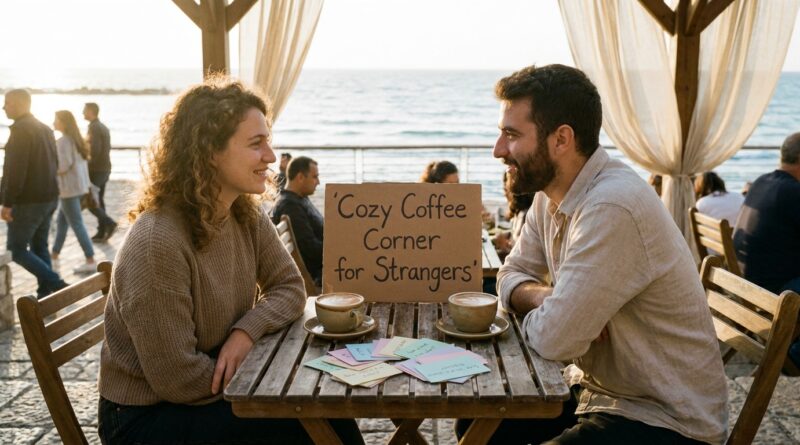
Why Tel Aviv Port’s New ‘Cozy Coffee Corners for Strangers’ Could Be 2026’s Bravest Answer To Social Anxiety In Real Life
You know the feeling. You save video after video of soft lighting, rain on café windows, cinnamon foam, strangers smiling like conversation is the easiest thing in the world. Then you walk into a real coffee shop in Tel Aviv, hear cups clatter, chairs scrape, people laugh too loudly, and suddenly your safest move is staring at your phone. That is not you failing at being social. It is your nervous system doing what it does when a place feels unpredictable. That is why Tel Aviv Port’s idea of “Cozy Coffee Corners for Strangers” feels so brave. It does not ask you to become outgoing overnight. It gives you a smaller target. A set time. A softer setting. A simple reason to sit near someone without the pressure of networking, flirting, or performing. For anyone searching for a cozy coffee shop for social anxiety in Tel Aviv, this kind of setup could be the difference between wanting connection and actually trying it.
⚡ In a Hurry? Key Takeaways
- “Cozy Coffee Corners for Strangers” works because it lowers the social stakes and gives shy people a script, not a spotlight.
- If you want to try it, go with one tiny goal, like staying 20 minutes or saying one sentence to one person.
- The real value is not instant friendship. It is feeling a little safer around people, which matters more than another loud event ever could.
Why this idea matters more than it sounds
On paper, a coffee corner for strangers can sound almost too simple. A few tables. Maybe a sign. Maybe a host. Maybe a prompt card that says something gentle like, “What is one small thing making your week easier?”
But simple is the point.
A lot of people are not avoiding connection because they hate people. They are avoiding the chaos that often comes with it. Unclear expectations. Noise. The fear of getting stuck. The awkward question of whether someone wants to talk or be left alone.
This is where a cozy coffee shop for social anxiety in Tel Aviv can do something smarter than a meetup app or a big social mixer. It can make the rules visible. You are here for light conversation. You can leave whenever you want. Silence is allowed. Looking nervous is normal.
That kind of framing takes a huge load off the brain.
What “Cozy Coffee Corners for Strangers” likely gets right
1. It gives people a script
Social anxiety gets worse when every choice feels open-ended. Where do I sit? Do I interrupt? How long do I stay? Am I weird if I bring a book? A good corner for strangers answers those questions before they become stress.
Maybe there is a shared table marked for casual conversation. Maybe there are color cards. Green means open to chat. Yellow means quiet company only. Maybe there is a simple host who welcomes people without making a scene.
That is not childish. It is considerate design.
2. It keeps the interaction low-pressure
The best version of this is not speed-friending with latte art. It is softer than that. More like permission to exist near other humans and let conversation happen if it happens.
That matters because social confidence often comes back in layers. First you tolerate the space. Then you make eye contact. Then you ask what someone ordered. Then maybe, after a few visits, you remember their name.
Those are not small wins. They are the whole game.
3. It fits the way coffee culture is changing
For years, cafés were sold as work zones. Bring your laptop. Take your calls. Be productive. Or they were sold as photo-ready places to be seen.
That is shifting. More people want places that help them regulate, not perform. Slow rituals. Softer sound. Seats that do not feel like a contest. If that sounds familiar, it connects naturally with Why Tel Aviv Port’s ‘Sensory-Soft Coffee Mornings’ Could Be 2026’s Kindest Escape For Overstimulated Minds, which gets at the same truth. Sometimes the problem is not “being antisocial.” Sometimes the room is simply too much.
Why Tel Aviv Port is a smart place for this
Tel Aviv Port already has something many anxious people need. Movement without total confinement. You can walk by the sea first. You can arrive early and circle once. You can leave and still feel like you had an outing, even if the social part was brief.
That escape hatch matters.
For tourists, remote workers, new immigrants, students, freelancers, and parents stealing a quiet hour, the port also offers a rare middle ground. It is public, but not too formal. Lively, but it can still hold pockets of calm. You are not entering someone else’s tight-knit friend group. You are entering a shared civic space.
That makes trying easier.
What makes this a brave answer to real-life social anxiety
The brave part is not the furniture or the coffee.
The brave part is admitting that many people do want connection, but not the version that comes with pressure, performance, and emotional risk right out of the gate. We have spent years acting like the only cure for loneliness is “put yourself out there,” which is often terrible advice when your body hears that as “go get overwhelmed in public.”
A better approach is graded exposure with dignity.
You do not throw someone into a loud mixer and call it healing. You create a gentle ritual they can repeat. Same place. Same tone. Same basic expectations. That repetition helps the brain stop reading every social moment as a threat.
How to use a setup like this without making yourself miserable
Pick a goal smaller than “make a friend”
That goal is too big for a first visit. Try one of these instead:
- Stay for 15 to 20 minutes.
- Order your drink and sit in the designated corner.
- Say one sentence to one person.
- Ask a simple question like, “Have you been here before?”
- Leave before you get flooded, not after.
If you meet that goal, the visit worked.
Use the environment as your conversation starter
You do not need a brilliant opening line. In fact, please do not put that pressure on yourself. The easiest social glue is shared context.
- “I like that this is quieter than most places.”
- “I was nervous to come, honestly.”
- “Do you know what drink is good here?”
- “I like that this place doesn’t feel like an event.”
That last line is especially useful because it says exactly what many other people are thinking.
Give yourself a role
People often do better when they know what “kind” of person they are in a social setting. You can be the person reading with occasional chat. The person who asks one warm question. The person who compliments pastries. The person who comes every Tuesday at 10.
Roles reduce panic because they narrow the options.
What café owners and organizers can learn from this
If this concept catches on, it should not be copied carelessly. The details matter.
Quiet beats hype
If the corner is marketed like a buzzy attraction, it defeats the point. The design should say, “You are safe to be ordinary here.” Not, “Come optimize your social life.”
Staff need to be warm, not overinvolved
A simple welcome is enough. Many anxious people like knowing someone kind is present, but they do not want to be managed.
Clear signals help everybody
Signs, table prompts, optional badges, posted time windows, and gentle rules make the whole thing easier to trust. This is social UX, really. Good design can remove half the fear before a person even sits down.
What this will not do, and why that is okay
It will not cure loneliness in one cappuccino.
It will not make every conversation magical.
It will not stop awkward pauses, and thank goodness for that. Normal human connection includes awkward pauses.
What it can do is more realistic and, honestly, more useful. It can help people collect a few lived experiences where being around strangers was manageable. Maybe even pleasant. That is how confidence usually returns. Not as a dramatic breakthrough. As a series of ordinary moments your body survives.
At a Glance: Comparison
| Feature/Aspect | Details | Verdict |
|---|---|---|
| Pressure level | Structured, casual, and easy to leave. No need to “work the room.” | Much better for anxious people than a loud networking event. |
| Conversation support | Shared seating, prompts, soft hosting, and visible social cues can reduce guesswork. | Strong if the setup is clear and consistent. |
| Long-term value | Builds repeat contact for locals, visitors, and remote workers through small, regular interactions. | A smart piece of gentle social infrastructure. |
Conclusion
Social feeds are full of cozy clips and mental health talk, yet plenty of people still feel their chest tighten the minute real-life contact becomes possible. That gap matters. It is where loneliness hardens and neighborhoods start to feel less like communities and more like waiting rooms. A clearly framed idea like “Cozy Coffee Corners for Strangers” offers something refreshingly practical. Not forced intimacy. Not a performance. Just a specific time, place, and script for trying human contact without feeling trapped. For anyone looking for a cozy coffee shop for social anxiety in Tel Aviv, that is more than a trend. It is a usable bridge between watching comfort online and feeling a little safer in person. And if Tel Aviv Port can make that ritual repeatable for shy regulars, tourists, new immigrants, students, and tired parents alike, it could help the area feel like a small village again, one careful cup at a time.